Text
SAFEWORDS
When I visited Owen in his Alexandria studio to see the works he was making for Heavy Leather, I was immediately pulled towards a circular arrangement of white forms placed equidistantly on the studio floor. A closer inspection revealed they were cast jockstraps, compositionally akin to those discarded whilst undressing––and, to the attuned viewer, evocative of a circle jerk. Although affirmed as an accurate interpretation by the artist, the response felt punctuated by an ellipsis––an early indicator that the exhibition would lend itself to subjective interpretations, pluralities, and echoes. Here, Owen is suggestive but never absolute; teasing, edging us with meaning but never consummating the read.
In this encounter, the queer charge of Owen’s recent works were summoned to the fore, revealing a coded queer language––both visual and material––that can be understood by those that speak this tongue. It suggests that literacy in the queer lexicon of language, space, and behaviour, renders legible a layer of social and affective reality that is superimposed upon the everyday – and the exhibition itself.
With fluency, how objects are positioned and materials like leather, rubber, chains, jockstraps and bedsheets, exceed their individual associations. Instead, they are laden with homoerotic tendencies and kink symbolism, as is the artist’s intent. At their intersection, queer and BDSM communities both use codified vocabularies as mechanisms of protection, connection and care.
Owen offsets power with power: the exhibition becomes an arena where oppression and liberation collide to reveal its capillary functioning. That is, how power circulates, diffuses and operates microscopically as a dynamic and complex network of relationships embedded across political, social and cultural structures. Through his evocative works, Owen positions pleasure as an embodied knowledge, foregrounding the erotic as a liberatory form of power that both reveals oppressive forces and transforms them, offering collective queer joy and the freedoms of our sensuality as an antidote.
“But when we begin to live from within outward, in touch with the power of the erotic within ourselves, and allowing that power to inform and illuminate our actions upon the world around us, then we begin to be responsible to ourselves in the deepest sense. For as we begin to recognize our deepest feelings, we begin to give up, of necessity, being satisfied with suffering, and self-negation, and with the numbness which so often seems like the only alternative in our society. Our acts against oppression become integral with self, motivated and empowered from within.”
It begs the question: can pleasure itself redistribute power? Considering it as variably both relational and authoritarian, the artist’s interrogation of power distribution is not linear––but circular––where his preference of ‘power-over’ and ‘power-with’ becomes slippery, oscillating, and context dependent.
Sex Magic (2026) is an example of this. Disparate meanings become interlinked as the artist’s bronze-cast hand tenderly cradles a length of heavy-duty chain. Here, constraint and connection coexist: what might signify oppression or imprisonment in one context can also signify intimacy, pleasure or agency in another. Communal by design, no link exists in isolation. The chain’s strength is contingent on its relation to the next. Yet this chain is not made from the store-bought metal hardware one might expect, but from hand-crafted glass arduously bound together. The chain is transformed into a healing tool of vulnerability, where its transparency opposes the occlusive force of coercive power, and demands it be held with care.
A safeword is a pre-arranged code word or visual signal used by a person during sex to communicate their physical or emotional state. They are essential tools for bodily autonomy and form an integral part of the vernacular used by BDSM communities to set boundaries and provide participants agency to let go of inhibitions in a safe environment. These words are used as protection and are implemented to dispel activities and the power dynamics temporarily in place.
In this arena, control, consent and power are negotiated. Submission and domination between people forms a circular economy of pleasurable currencies where power operates in a mutually beneficial way; who holds it and who yields to it is decided democratically amongst those partaking in an act that centres shared pleasure and respect. It is an alternative model of power in itself, where control is consensual. Self-actualisation is bound to community and power becomes a bridge between the self and liberating relational possibilities; power is considered connective rather than inimical (unless consent is given of course). Unfortunately, as we are all aptly aware, power in other realms of life is not always up for negotiation.
Droplets rendered in fragile and gently coloured glass and silk are located throughout the exhibition. Unpuddled, they are suspended from the base of soft-sculptures and wall hangings, or dangle carefully from the artist’s protective, taloned bronze cast hands. These equivocal forms could be identified as a range of bodily fluids: sweat, blood, tears, semen or saliva. Deliberately multivalent, Owen is not prescriptive here. Instead, he appears more concerned with challenging heteronormative thresholds between the ‘inside’ and ‘outside’, positioning the body as a site which is inherently messy and interconnected.
Pushing further: it could be considered a commentary on the politicisation of bodily fluids and the ways in which the state regulates and polices them according to the bodies they inhabit. Historically, the control of these fluids has been a tool for biopolitical governance, determining who is deemed safe or dangerous within society, which has often linked queer people with social contagion panics.
Pushing further still: these droplets have also been considered symbolically by Owen as an emotional overflow or ‘spillage’ of feelings. In conversation, the artist has described himself as somatic and sensory in how he experiences the world, yet has a highly regimented operational default. When he feels powerful emotions like love and joy, his body cannot contain it and his system becomes overwhelmed – and somewhat saturated. Here, order and structure offer safety and the containment of leaks.
A multivalency of meaning emerges across Soft Opening 1-3 (2026), where Owen has structurally drawn from non-representational ink blot experiments to construct soft sculptures. Corrosive radial bleach stains, suggestive of seeping bodily fluids, emanate from the centre of each form, held together by a glass torus. For him, these works are evocative of many things: sexually they could be bodily orifices, mythologically they could be considered portals to other realms, symbolically they might be apertures to look through (and beyond), or in a more poetic gesture, they could be an invitation – to open oneself softly to new understandings of queerness and community.
Rather than resolving these frictions, Owen asks us to remain with them and to find comfort in the indeterminate. Occupying thresholds rather than endpoints, the works’ ambiguity is not the absence of meaning, quite the contrary. Instead, it is the refusal for singularity or fixed systems towards more relational understandings of connectivity and to cultivate a collective becoming; ambiguity invites participation.
In the studio, Owen is in constant negotiation with his materials and how they behave, in what could be considered a sub/dom relationship. Shifting between control and release, he often gives himself parameters––or permission––to ‘be messy’. A tension presides as he frequently succumbs to his impulse for discipline and order; it becomes a game.
This power exchange is particularly evident when studying the anomalous Chinese ink blots that subsume the artist’s deconstructed bed sheets in HEAVY LEATHER (2026), PIGGY (2026), and DADDY (2026). As an automatic drawing technique, the ink blots experiments allow Owen to access his subconscious and bypass his defense mechanisms in a queering of the process; a drop of ink on an expanse of the bedsheet disrupts the sterility of the social fabric.
To play the game, he creates a contingent field of order––neatly folding the sheets and ironing its edges––before (temporarily) submitting as the ink forms organically come into being. An assessment of the inkblots leads to a projective Rorschach test, perhaps measuring emotional functioning or one’s personality: where some might see malevolence, others see joyful intervention. The power dynamic shifts again, observed in the artist’s reassertion of authority over the material by dominating the stained surface with heavy stencilled text. It does tell us a bit about Owen’s personality: he likes to be in control.
A further assessment: how might one analyse the act of Owen developing his own unique inkblots––a coded visual language in itself that is familiar enough to invite recognition, yet sufficiently unfamiliar to demand deciphering––as a departure from Rorschach’s standardised model, in what echoes a Warholian subversion of the test?
Heavy Leather is positioned as a resistance against what Owen calls ‘the shadow of patriarchy’, an invisible yet palpable androcentric system which impacts our bodily autonomy, decision-making, and ways of being. Described as ‘dark and unsettling’––an affective implication of using gothic and BDSM-core aesthetics–– he suggests his works are an expression of life lived within this oppressive shadow, casting the construction of queerness as shadowed by the primacy of heterosexuality.
But, darkness is not unfamiliar territory for queer folk and could be considered as a crucial part of a queer aesthetic as a refusal to cohere and be legible. The cover of darkness has offered safety and turns contained social-sexual spaces, like cruising spots and underground raves, into expanded places where nocturnal and covert environments allow for the embodiment of an authentic self and sexual liberation. It further positions what queer theorist Jack Halberstam conceives as the “disruptive potential of shadow worlds.”
Despite this dual reading, Owen is sure to remind us that there is no shadow without light:
“I invite audiences to consider how stepping into the light of one's authentic self inevitably casts shadows, and how light and dark can be held, understood, and transformed as part of a deeper process of knowing and healing.”
Shadows also offer anonymity – which Owen politely declines. Instead, the exhibition itself could be regarded as entirely self-portraiture. Objects have become performing conduits for the artist's body, where caressing hands and penetrating fingers cast in bronze take on a libidinal function.
The singular and the collective collapse together in The Clearing (2026). Evoking the spatial logic of a circle jerk, resin casts of Owen’s jock-straps stand in as proxies for participating bodies, facing one another in a communal exchange of shared desire and pleasure. Irreducible to only the sexual, Owen posits that a clearing can also be a glade in a field, an exhalation of emotions, or the dispelling of oppressive forces. In a sense, it could be the clearing of space to hold space – to gather and mobilise for insurgency or a queer movement.
Anticipatory by condition, he turns to methods of speculation to summon forth queer potentialities and futures rooted in collective care, sexual liberation, and kinship. With ambiguity presiding throughout the exhibition, it appears that the queer future he’s proposing seems deliberately unresolved. It incites the idea that it must remain open to continual transformation and multiplicity to prevent it from becoming another closed system; we haven't yet arrived, but we are on our way.
“Queerness is not yet here... we can feel it as the warm illumination of a horizon imbued with potentiality.”
Squinting into the horizon, we can only hope that we can move towards the queer utopias that theorist José Esteban Muñoz asks us to feel.
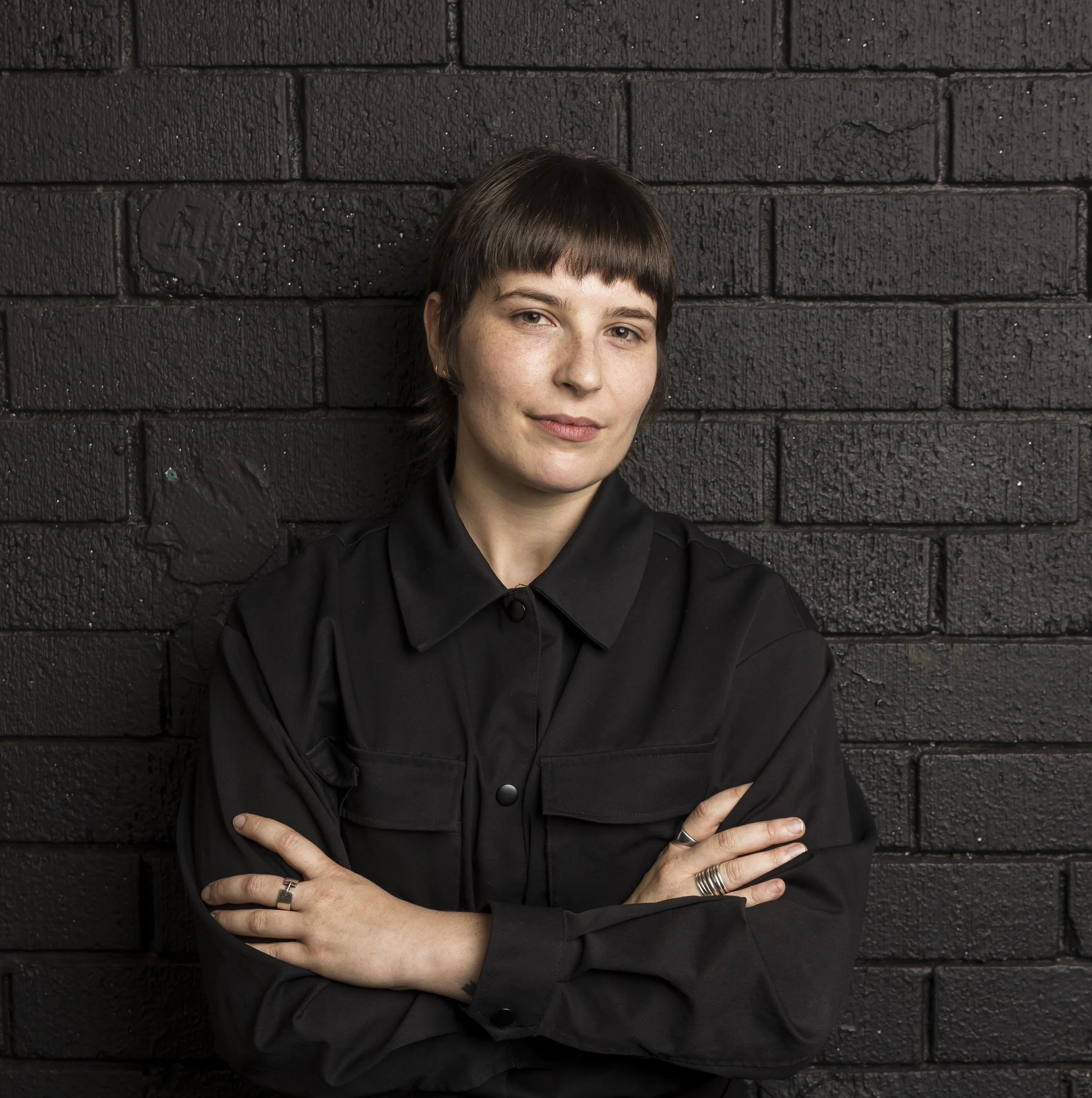
Photograph: Anna Kučera
Sarah Rose (they/she) is a Gadigal/Sydney-based curator and arts worker. In recent years, they have collaborated closely with artists nationally and internationally to develop contemporary art exhibitions, new commissions, and public programs. Their curatorial research currently focuses on queer ontologies, with a particular interest in how queerness disrupts and reorders normative systems.
Rose has worked across a range of leading Australian arts organisations and is currently Senior Project Officer, Visual Arts at Creative Australia, where they are part of the project delivery team for Australia’s presentation at the 61st La Biennale di Venezia. Prior to this, they were Associate Curator at Artspace, Sydney, and a Sessional Academic at UNSW Art & Design.
They have also held roles at the National Association for the Visual Arts (NAVA), Create NSW, and was the coordinator for Contemporary Arts Organisations Australia (CAOA), a national network of fifteen not-for-profit peer organisations from every state and territory. Rose is a co-founder of More Than Reproduction, an artist-run printmaking initiative supporting female-identifying and gender diverse printmakers across Australia. They hold a Master of Curating & Cultural Leadership with Excellence from UNSW Art & Design.